There is a class of objects from Greco-Roman antiquity called “grotesques” in which humans are presented with exaggerated, distorted features.
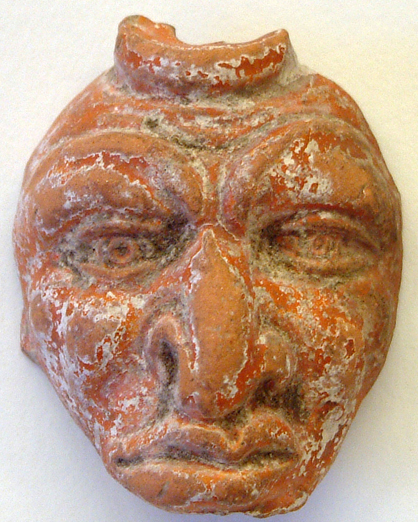
The reasons for the use of caricature in the Greco-Roman context are varied, but can generally be interpreted as a form of visual humor, a depiction of theatrical masks or figures from the theater, or portraits of people with specific pathologies.[1] One such fragment from the Mead’s collection (Fig. 1) depicts a face with a crooked nose and full, asymmetrical lips, all surrounded by deeply exaggerated wrinkles. Although its fragmentary nature and lack of secure findspot prevent any definitive interpretation of its original context and meaning, this object was perhaps part of a vessel and was probably intended to provoke laughter.

As we know, the use of exaggeration and caricature is a practice not limited to the ancient world. For example, the much-beloved Hoggle (Fig. 2), created by the brilliant puppeteer Jim Henson and a character in the 1986 cult-classic Labyrinth (starring David Bowie and Jennifer Connelly), is just such an example of the “grotesque” in the modern world. In fact, Hoggle and the Mead’s Grotesque Head Fragment closely resemble each other.
This ancient object and its modern doppelgänger tell us something about the effectiveness of caricature and exaggeration as visual cues. Because of their departure from the “norm,” the extreme treatment of their features grabs our attention and calls into question some of our assumptions. Hoggle’s “monstrous” appearance may be assumed, at first, to preclude human feelings of kindness and compassion, but in the course of the movie he defies those expectations, becoming the main character’s affectionate protector. Dreamworks’s Shrek similarly flouts the association of “ogre” with meanness.
While caricature’s meaning is contextual, as a form of visual communication it has been an effective means of visual transmission from antiquity to the present.
—Keffie Feldman
Cecelia (Keffie) Feldman is Kress Interpretive Fellow at the Mead Art Museum at Amherst College. She holds a PhD in archaeology from Brown University.
[1] A.G. Mitchell, “Grotesque Terracotta in the Greco-Roman world: The Role of Caricature in Visual Humour, of Theatrical Masks in the Realm of Comedy and of Portraits of Deformity in Ancient Medical Centres,” paper delivered at the 50th Congresso Nazionale SNO 2010 Parma, 19–22 Maggio 2010, Historical Panel “Storia, Arte e Neurologia?”
 What’s it like being at Amherst over the summer? And what qualifies Eric as “jazzy”? Read on!
 Mead Musings